
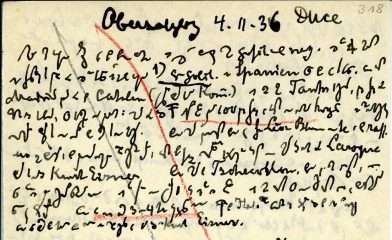
Even experts sometimes reach their limits when deciphering historical documents, for example when ancient wooden tablets are charred, scrolls have weathered, or notes are written in a rare form of shorthand. In two new projects, Vincent Christlein and his team aim to develop AI-supported technologies that make such sources easier to access. The Schmidt Sciences Humanities and AI Virtual Institute (HAVI) is funding the initiatives with about 900,000 USD over the next three years, one third of which will go to the FAU/PRL.
Project 1: Deciphering the lost art of stenography
Particularly in the 19th and early 20th centuries, numerous manuscripts were written in the rare Gabelsberger shorthand system. These include notes by the mathematician and philosopher Kurt Gödel, the physicist Erwin Schrödinger, the jurist and politician Carl Schmitt, the author Erich Kästner, and Munich’s Archbishop Cardinal Faulhaber. “The manuscripts and diaries contain material of historical and intellectual relevance. However, today only very few people are still able to read this script, meaning that many archival collections are practically inaccessible,” says project leader Dr. Vincent Christlein of FAU’s Chair of Pattern Recognition. Together with Nikolaus Weichselbaumer of the University of Mainz, Christlein aims to train and further develop AI-based handwriting recognition so that stenographic writing can also be machine-read.
Project 2: Processing text in damaged manuscripts

Ancient manuscripts are often illegible because they have suffered severe damage. A well-known example is the papyrus rolls and wooden tablets from Herculaneum near Pompeii, which survived the eruption of Vesuvius in 79 CE but were heavily carbonized. “Modern imaging methods such as multispectral photography or X-ray tomography can make remaining traces of ink more visible and thus easier to read. The main problem is that the substrate material has holes and tears, and that individual papyrus layers often cannot be separated without destroying them,” explains Vincent Christlein. The latter also applies to the Manichaean codices from Medinet Madi in Egypt, which are also part of the project’s focus. Researchers from Erlangen, the USA (Paul Dilley, University of Iowa; James H. Brusuelas, University of Kentucky), and Italy (Federica Nicolardi and Gianluca Del Mastro, Centro Internazionale per lo Studio dei Papiri Ercolanesi) are developing an AI tool that not only performs text recognition but also diagnoses damage and generates content suggestions for missing passages.
AI with and for the humanities
“We collaborate from the very beginning with experts in the humanities who provide feedback on the training data,” Christlein explains. “This enables us to develop valid evaluation criteria that connect computer science methods with humanistic editorial practices.” The AI models will initially be trained on existing sources from shorthand and papyrus collections. The goal of both projects, however, is to create universal tools that can decipher hard-to-access sources and thereby enrich humanities research.
Schmidt Sciences Humanities and AI Virtual Institute (HAVI) Award 2025
Both projects are funded through the Humanities and AI Virtual Institute (HAVI) Award 2025. With this award, the Schmidt Sciences foundation supports 23 research teams worldwide seeking new ways to bring artificial intelligence into dialogue with the humanities, spanning archaeology, art history, literature, linguistics, and film studies. The program’s mission is to use AI methods to unlock historical records while also drawing on humanistic questions, methods, and values to advance the design and use of AI itself.
For the original text in German, please visit: https://www.fau.de/2025/12/news/steno-papyrus-holz-ki-soll-wertvolle-schriften-entschluesseln/